RoPE Explained: The Positional Encoding Trick Behind Modern Language Models

When people talk about transformers, they usually focus on attention, scale, or training data. But one smaller design choice has an outsized effect on model quality: How does the model know where each token appears in the sequence? That question matters because transformers do not understand order by default. Without positional information, a sequence starts to look more like an unordered set of tokens than a structured sentence, paragraph, or program. ...

March 19, 2026 · 10 min · Nitin
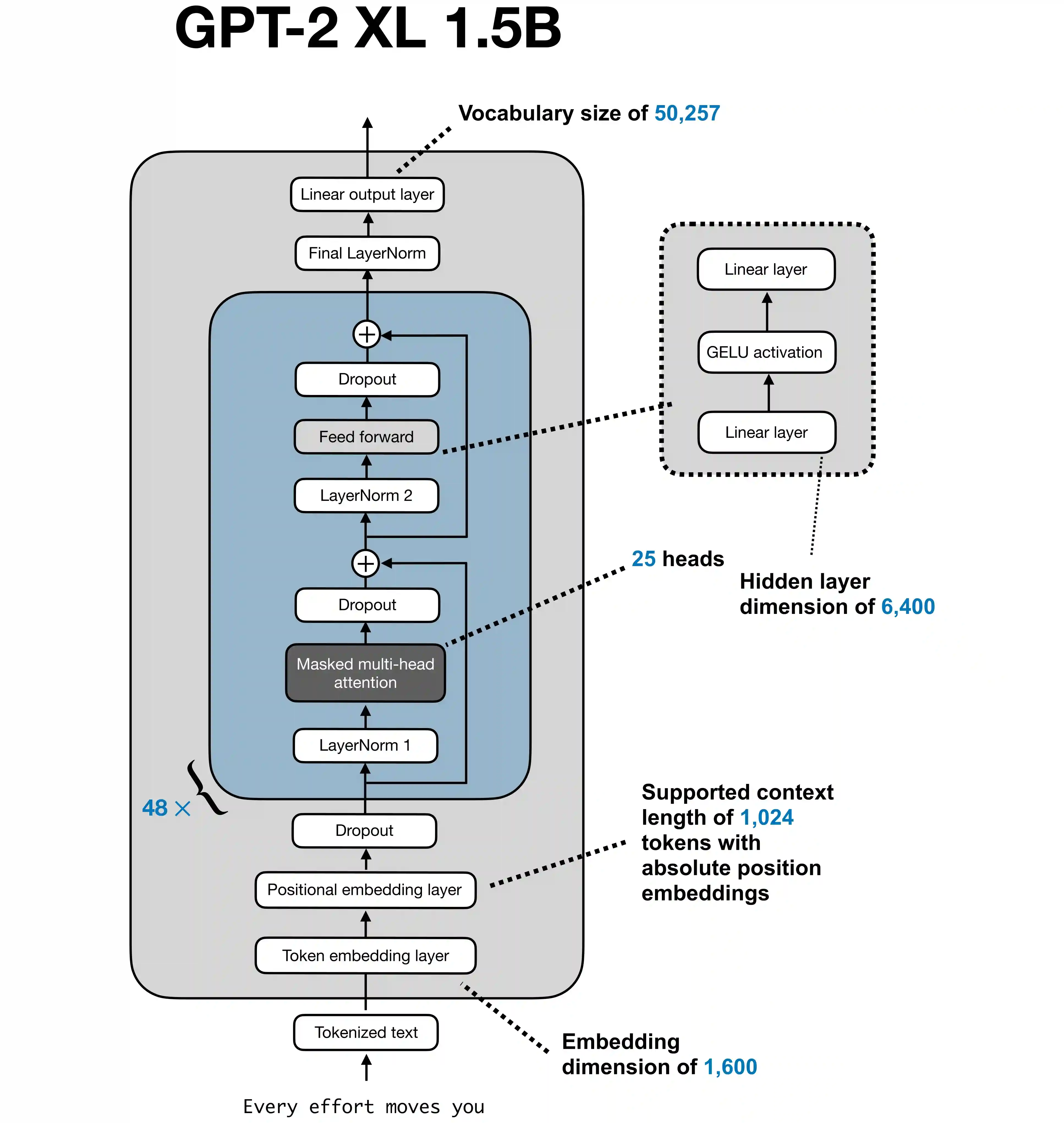
GPT-2 XL architecture diagram showing token embeddings, positional embeddings, 48 transformer blocks, 25 attention heads, and the output layer

Understanding LLM Architecture: Layers, Transformer Blocks, and Attention Heads

Large Language Models (LLMs) such as GPT-2, GPT-3, LLaMA, and BERT are built on top of the Transformer architecture. That architecture changed natural language processing by replacing recurrence with attention, which lets models process sequences more efficiently and capture long-range relationships more directly. If you are trying to understand what terms like layer, transformer block, and attention head actually mean, the easiest way is to follow the path a sentence takes through a GPT-style model. ...

March 16, 2026 · 8 min · Nitin
How Attention EvolvedFrom sequence-to-sequence alignment to long-context decoder efficiency.2014Bahdanauadditive attention2015Luongdot-product styles2017Transformermulti-head self-attn2019-2023Sparse, local,linear, MQA, GQA2024-2025DeepSeekMLA focusThe trend is consistent: keep the expressive power of attention, then remove its biggest bottlenecks.

Attention Mechanisms Explained: Self-Attention, Cross-Attention, Sparse Attention, MQA, GQA, and DeepSeek MLA

Attention is the idea that made modern transformers practical and powerful. Instead of compressing an entire input into one fixed vector, a model can decide, token by token, which earlier pieces of information matter most right now. That sounds simple, but there are many different kinds of attention mechanisms, and they exist because models face different constraints: some need strong alignment between an encoder and a decoder some need to generate text one token at a time without looking ahead some need to handle very long documents some need to reduce GPU memory traffic at inference time This article walks through the main families of attention, shows where they fit, and explains why newer variants such as DeepSeek’s multi-head latent attention (MLA) matter. ...

March 9, 2026 · 14 min · Nitin

Q K V : Query (Q), Key (K), and Value (V) Vectors in the Attention Mechanism

Introduction In the attention mechanism used by Large Language Models (LLMs) like transformers (e.g., GPT), the core idea is to allow the model to dynamically focus on relevant parts of the input sequence when generating or understanding text. This is achieved through a process called scaled dot-product attention, where input tokens (e.g., words or subwords) are transformed into three types of vectors: Q K V, Query (Q), Key (K), and Value (V). These are not arbitrary; they’re learned projections of the input embeddings via linear transformations matrices ...

October 1, 2025 · 3 min · Nitin

DeepSeek R1: A Deep Dive into Algorithmic Innovations

The recent release of DeepSeek R1 has generated significant buzz in the AI community. While much of the discussion has centered on its performance relative to models like OpenAI’s GPT-4 and Anthropic’s Claude, the real breakthrough lies in the underlying algorithmic innovations that make DeepSeek R1 both highly efficient and cost-effective. This post explores the key technical advancements that power DeepSeek’s latest model. Model Architecture and Training DeepSeek R1 is part of a broader model ecosystem, and it’s essential to distinguish between two key models: ...

February 6, 2025 · 5 min · Nitin

Unveiling the Secrets Behind ChatGPT – Part 1

Introduction Hello everyone! By now, you’ve likely heard of ChatGPT, the revolutionary AI system that has taken the world and the AI community by storm. This remarkable technology allows you to interact with an AI through text-based tasks. The Technology Behind ChatGPT: Transformers The neural network that powers ChatGPT is based on the Transformer architecture, introduced in the 2017 paper “Attention is All You Need.” GPT stands for “Generatively Pre-trained Transformer.” The Transformer architecture is a landmark development in AI that revolutionized the field, primarily in natural language processing (NLP). The Transformer architecture, initially designed for machine translation, became the backbone for numerous AI applications, including ChatGPT. ...

June 17, 2024 · 5 min · Nitin