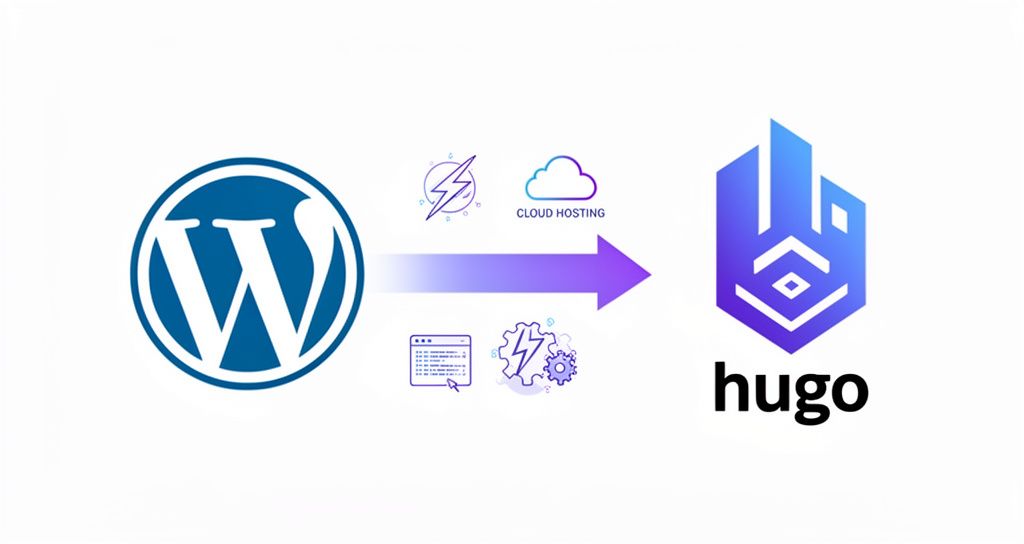
Migrating WordPress to Hugo with Cloudflare Pages

How to Migrate WordPress to Hugo with Decap CMS and Cloudflare Pages (Free Hosting)

Why Migrate from WordPress? WordPress is powerful, but for a technical blog that mostly serves static content, it comes with unnecessary overhead — hosting costs, plugin updates, security patches, and slower page loads. Static site generators like Hugo offer a simpler, faster, and cheaper alternative. Here’s what we migrated to: Hugo — blazing fast static site generator PaperMod — clean, minimal theme perfect for tech blogs Decap CMS — web-based content management with GitHub backend Cloudflare Pages — free hosting with global CDN Google AdSense — preserved auto ads from the WordPress site The result? A site that builds in under 1 second, costs $0/month to host, and is served from Cloudflare’s global edge network. ...

February 8, 2026 · 5 min · Nitin

Agentic Context Engineering (ACE): Turning Context Into a Self-Improving Playbook for LLMs

Large language models are getting smarter—but the real superpower may be how we feed them context. Instead of constantly fine-tuning weights, a growing family of techniques improves models by upgrading the inputs they see: richer instructions, reusable strategies, domain heuristics, and concrete evidence. The paper “Agentic Context Engineering: Evolving Contexts for Self-Improving Language Models” proposes ACE, a practical framework that treats context like an evolving playbook—something you grow, refine, and curate over time to make agents and reasoning systems measurably better. ...

October 22, 2025 · 9 min · Nitin

Byte Pair Encoding (BPE): the tokenizer that made GPTs practical

Introduction Byte Pair Encoding (BPE) is a subword tokenization scheme that gives us the best of both worlds: compact vocabulary sizes (not the full wordlist), the ability to represent any unknown word (by falling back to subwords/characters), and meaningful shared pieces (roots, suffixes) that help models generalize. GPT-2 used a BPE tokenizer with a vocabulary of ≈50,257 tokens, and OpenAI’s tiktoken is a fast Rust-backed implementation you can use today. Below I explain the why, the how (intuition + algorithm), and a short hands-on demo using tiktoken. ...

September 27, 2025 · 4 min · Nitin

Supervised Fine-Tuning (SFT)

What is Supervised Fine-Tuning (SFT)? Supervised fine-tuning is a training strategy where a pre-trained language model is further refined on a carefully curated dataset of prompt-response pairs. The primary goal is to “teach” the model how to generate appropriate, contextually relevant, and human-aligned responses. Key points about SFT include: Data Curation: The model is exposed to a dataset that contains high-quality examples—often created by human annotators—that demonstrate the desired behavior (e.g., step-by-step reasoning, correct coding outputs, or helpful dialogue responses). Instruction Following: By training on these examples, the model learns to interpret prompts as instructions and produce answers that mimic the reasoning and style of the training data. Limitations: While SFT works well to instill basic response quality, it is typically limited by the dataset’s scope and may not encourage the model to “think” beyond what is explicitly provided. Furthermore, excessive fine-tuning can lead to overfitting and reduce the model’s ability to generalize to unseen tasks. For many contemporary language models, SFT is the standard method used to bridge the gap between raw pre-training and interactive, user-facing performance. ...

February 2, 2025 · 5 min · Nitin

Understanding Tokenization in Large Language Models: A Deep Dive – Part 1

Tokenization is a fundamental yet often misunderstood process in the realm of large language models (LLMs). Despite its crucial role, it is a part of working with LLMs that many find daunting due to its complexity and the numerous challenges it introduces. In this blog post, we will explore the concept of tokenization, its importance in language models like GPT-2, and the various issues associated with it. Introduction to Tokenization Tokenization is the process of converting raw text into smaller units called tokens. These tokens can be as small as individual characters or as large as entire words or subwords, depending on the specific tokenizer being used. Tokenization is the first step in feeding text data into a neural network, making it a critical component in the performance of LLMs. ...

August 17, 2024 · 6 min · Nitin

Convolutional Neural Networks

Introduction This blog post dives into the fascinating world of computer vision, exploring how we can teach machines to “see” using convolutional neural networks (CNNs). This post is based on a lecture from MIT’s 6.S191: Introduction to Deep Learning course. What Does it Mean to “See”? Before diving into the technical details, let’s define “vision”. It’s not simply about identifying objects in an image. True vision goes beyond object recognition to understand the relationships between objects, their movements, and their future trajectories. Think about how you intuitively anticipate a pedestrian crossing the street or a car changing lanes. Building machines with this level of visual understanding is the ultimate goal. ...

May 26, 2024 · 10 min · Nitin